Lesbos, a Greek island located in the eastern Aegean, had several prosperous city-states which thrived from the Bronze Age to the Byzantine era. Switching many times between independence, Persian and Greek control, Lesbos was often a victim of its geographical location on the edge of the Greek world. The island was famous in antiquity for its wine and its culture, producing many famous names over the centuries, notably the poetess Sappho, the statesman Pittakos, and the philosopher Theophrastus.
According to Greek mythology, the island was the birthplace of the hero Lesbos. The island features in the Trojan War story of Homer’s Iliad, notably when Agamemnon offers Achilles, amongst other things, seven women from Lesbos skilled in handicrafts, in order to persuade the hero to rejoin the conflict. Agamemnon must have known of the great warrior’s admiration of the women of Lesbos because Achilles had brought one as his partner for the duration of the war, Diomede, daughter of Phorbas. The king also mentions in passing that Achilles had captured the island, presumably on their way to Troy, and that it had then been part of the Trojan Empire of King Priam.
In Mythology
The island is a brief stopping point for Odysseus in Homer’s Odysseyand the hero’s son Telemachus recounts (twice in fact) how his father successfully wrestled Philomeleides, the king of Lesbos who loved to challenge all comers for a bit of rough and tumble, with death the loser’s stark reward.
Finally, in some accounts the head of Orpheus, that great lyre player, washed up on the shores of Lesbos after the poor youth had been ripped to pieces by a group of frenzied Maenads. There, the Muses buried it and built a shrine where birds would sing in such a fashion as to recall his fabulous lost talent. Orpheus’ lyre, also smashed by the Maenads, is said to have washed up on the island, too, where it was discovered by a fisherman and given to the famed 7th-century BCE musician and poet Terpander.
Historical Overview
Bronze Age Lesbos
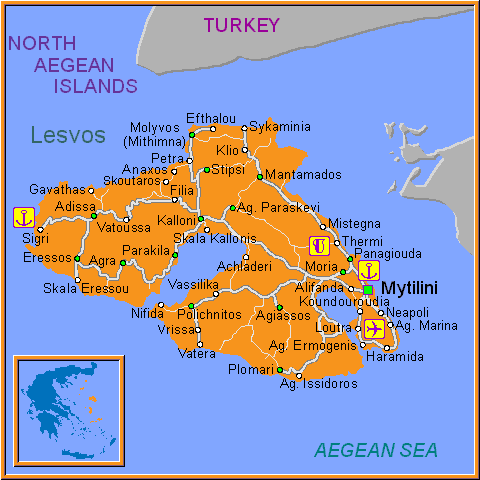
The island of Lesbos is located in the northeastern Aegean, off the west coast of Turkey, and it is the third-largest Greek island measuring some 1,630 sq. km (629 sq. mi). Inhabited since the Neolithic period, the island prospered in the Bronze Age but was, being only 10 km (6 miles) from the Turkish coast, closer in culture to Anatolia than the Mycenaean civilization on mainland Greece. At this time the most important settlement was Thermi on the coast, named after its hot springs. In the late Bronze Age (10th century BCE) there was perhaps a significant wave of immigration to Lesbos from mainland Greece, most likely the Thessaly region, and the Aiolic dialect was widely spoken on the island thereafter. There remained a distinctive culture which mixed Greek, Anatolian, and indigenous cultural practices. Unique elements included the production of grey bucchero pottery. The island prospered largely thanks to its production and export of olives, olive oil, and wine, as evidenced by finds of Lesbian amphorae across the Greek world.
THE POLIS OF MYTILENE, THE ISLANDS’ MOST IMPORTANT, WAS SIMILAR IN SIZE TO ATHENS IN ITS HEYDAY.
Greek Lesbos
In the Archaic period, the Penthelid dynasty dominated the island as tyrants, but according to Aristotle (384-322 BCE), they were kicked out by a group of aristocrats c. 630 BCE. The island was able to support a naval force which allowed it to control areas in Anatolia (Asia Minor) to the east and Thrace to the north. Major city-states dotted across the island included Antissa, Eresus, Methymna, Pyrrha, and the most powerful polis of all, Mytilene, which was similar in size to Athens in its heyday. The ruins of fortifications and rural watchtowers – perhaps to protect mineral mines – would suggest that there were sometimes military clashes between the cities, while the presence of artificial harbour moles in several towns illustrates the naval and commercial strength of the island. Important religious temples were built at Klopedi in the countryside (dedicated to Apollo) and at Mesa. Mytilene had a temple dedicated to Demeter and Kore while there was a sanctuary to Dionysos at Methymna, perhaps no coincidence given the town’s reputation for its fine wine. Cybele, the mother goddess, was worshipped in several towns, another link with Anatolian culture.